
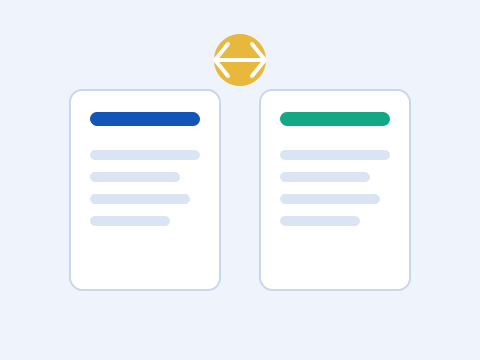
Searching for the best IPTV provider usually returns a wall of near identical looking review sites, most of which rank providers based on affiliate commission rather than actual quality. Since streaming performance depends heavily on your own internet connection, device and location, a ranking that ignores those variables is not especially useful.
Instead, this page gives you a structured way to compare providers yourself, based on the factors that reliably affect quality rather than marketing claims.
What makes a good IPTV provider
Strip away the marketing and a good provider comes down to a short list of fundamentals: servers that hold up under real demand, honest communication about what is included, straightforward setup, and support that actually responds when something goes wrong. Everything else is secondary to those four things.
Questions worth asking before you commit
A short conversation before you pay tends to reveal more about a provider than any amount of reading review sites. Worth asking directly: how many connections are included at each plan length, which credential formats are supported, what happens if a device you own turns out not to work well, and how renewals are handled. A provider that answers these clearly and without hesitation is generally a better sign than one that gives vague or evasive responses.
Comparing providers on a level playing field
It is tempting to compare providers purely on price, but that comparison only makes sense once you have confirmed the plans actually match. A cheaper plan with fewer connections, no Xtream Codes support, or unclear renewal terms is not necessarily better value than a slightly more expensive plan that fits your household properly. Write down what you actually need, in terms of connections, devices and app support, before comparing prices, so you are comparing genuinely equivalent options rather than being drawn to the lowest headline number.
Reliability
Reliability is about consistency over time, not a single good night of streaming. Server capacity needs to scale with the number of active subscribers, which is most visible during high demand periods such as major sporting fixtures. A provider that performs well on a quiet Tuesday evening but struggles on a Saturday during a big match is not actually reliable, just under tested.
Content availability
Channel lists and on demand libraries vary between providers, and availability of specific content can change over time. Rather than judging a provider purely on the size of its channel list, consider whether it covers the categories you actually watch, since a smaller, well maintained list often performs better than an enormous one spread across overloaded servers.
Device compatibility
Confirm upfront whether a provider works cleanly with the devices already in your home, including any older Smart TVs or set top boxes. Our IPTV devices guide covers the compatibility considerations for the most common hardware.
App support
Providers that support both M3U and Xtream Codes give you flexibility to choose whichever app suits your device best, rather than being tied to one player. See our IPTV apps guide for how the popular options compare.
Connection options
Check how many simultaneous connections are included at each plan tier, and whether additional connections are available if your household grows. This single detail prevents more support complaints than almost anything else, since exceeding your connection limit is a common and easily avoidable cause of a stream cutting out.
Streaming quality
Ask specifically what quality tiers are realistic on your connection rather than accepting a blanket claim of 4K everywhere. A provider that is transparent about quality varying by channel and server load is generally more trustworthy than one promising perfect quality on every single stream.
Customer support
Direct, responsive support during setup and renewals is one of the clearest signals of a well run provider. Look for services that offer real time channels such as WhatsApp rather than slow email ticket systems, particularly if you are setting up multiple devices.
Pricing
Compare pricing against plan length and connection count together, not price alone. A cheap single connection plan is not better value than a slightly more expensive plan with two connections if your household needs both. Our subscription guide lays out current plan options in detail.
Subscription terms
Understand exactly what happens at renewal, whether pricing stays consistent, and what your options are if you want to change plan length later. Clear terms upfront save confusion down the line.
Setup
A provider should be able to explain setup clearly in a few steps. If getting started feels unnecessarily complicated or under explained, that is often a preview of what ongoing support will be like. Our setup guide walks through the general process.
Refund and cancellation considerations
Because IPTV access is typically activated immediately and involves digital credentials, refund policies tend to be more limited than physical goods. Ask about the specific policy before you pay so there are no surprises later.
Security and privacy
Be cautious with any provider that asks for more personal information than necessary to process an order. A straightforward transaction should not require extensive personal details beyond what is needed for payment and delivering your login credentials.
Legal considerations
IPTV as a technology is simply a delivery method for television and video over the internet. It is your responsibility to ensure that any service and content you use is properly authorised and compliant with the laws in your own country. Reputable providers are transparent about this rather than making vague or evasive claims about legality.
How provider quality changes over time
A provider that performs well today is not guaranteed to perform the same way in a year. Server infrastructure gets upgraded or neglected, support teams change, and pricing structures shift as the market evolves. This is one of the reasons we recommend starting with a shorter plan when trying a provider for the first time, and paying attention to your own experience over the trial period rather than relying solely on how a service was described when you first researched it.
Common mistakes when comparing providers
A few patterns lead people to a worse outcome than necessary. Choosing based on price alone without checking connection counts or app support is one. Assuming every provider's 4K claim means the same thing in practice is another, since actual quality depends heavily on server load and your own connection. Skipping the step of asking about support responsiveness before ordering is a third, since this is exactly when you are most likely to need help.
Signs a provider takes reliability seriously
A handful of practical signals tend to correlate with a better run provider. Clear, specific answers about connection limits and supported apps, rather than vague marketing language, suggest a service that understands its own product well. A willingness to explain what happens during high demand periods, rather than promising uninterrupted quality at all times, is a sign of realistic communication rather than overpromising. And a support channel that responds promptly to a pre sale question is a reasonable indicator of what post sale support will look like.
Weighing new providers against established ones
Newer providers are not automatically worse than long established ones, and established providers are not automatically more reliable simply through longevity. What matters more is current server capacity relative to current subscriber numbers, which is difficult to judge from outside but can be partly assessed by testing a shorter plan yourself and asking direct questions before committing. Treat provider age as a minor factor rather than a primary decision criterion.
Balancing channel variety against server quality
It is common to assume that more channels and a bigger on demand library automatically means a better service. In practice, a smaller, well maintained selection running on stable, well resourced servers often delivers a more satisfying experience than an enormous list spread across infrastructure that struggles under real demand. When comparing providers, weigh the breadth of what is offered against how consistently it actually performs, rather than treating channel count as the deciding factor on its own.
Trial periods and short term plans as a research tool
Reading about a provider only gets you so far. A short plan, used deliberately as a test rather than a full commitment, tells you more about real world performance on your own connection than any amount of further research. Treat the first month as an evaluation period: test multiple devices if you plan to use them, watch during a busy evening, and see how support responds if you have a question, before deciding whether to move to a longer term.
Building a shortlist rather than picking the first option
Rather than settling on the first provider you come across, it is worth building a short list of two or three options that appear to meet your core requirements, then comparing them directly against each other on the factors covered above. This does not need to take long. A focused comparison of connection counts, device support, pricing structure and how each responds to a direct question is usually enough to make a confident decision without extensive research. If a specific brand name keeps coming up in your own research, our Televo IPTV review shows how we approach evaluating a named provider using this exact framework.
Putting it together
Work through reliability, compatibility and support first, since those affect your day to day experience the most. Price and content library size matter, but only after the fundamentals are solid. When you are ready to compare specific plans, visit our IPTV subscription page for plan lengths, connection counts and ordering details.